
Portion Size Is the Real Pricing Lever
Why a fifteen-gram protein reduction is invisible to the customer and decisive for your margin, and the grams-to-cash maths that turns a small portion change into £6,000 a year.

🎧 Beyond the Pass — Operator Podcast (1:33)
Boost profits with invisible portion sizing
Prefer reading? The full breakdown is below.
A trader at a market in Bristol last year. Pulled pork rolls, eleven quid a portion, 180 grams of pulled pork per roll. Selling about 70 portions on a good Saturday across two pitches.
He told me he couldn’t put his prices up without losing customers. The £12 ceiling was real in his pitch type, he said. Anything above £11 and people walked.
He was right about the price ceiling. He was wrong about the lever he had available.
Eight weeks after we restructured his portion specification, he was still charging eleven pounds, still selling roughly seventy portions a Saturday, and making about £120 more in margin every market day. Across four markets a week, that was nearly £25,000 a year of recovered profit. He’d raised no prices, lost no customers, and added no hours of work.
He’d just stopped serving 180 grams of pulled pork when 160 grams was the right number.
This is the lever almost no street food trader uses properly, and it’s the lever that produces more recoverable margin than any other single change in a small operation. Portion size, costed correctly, is where the real money lives.
The customer cannot see a 10% protein reduction
Here is the operational truth that most traders refuse to believe until they test it. A 10% reduction in cooked protein weight, plated alongside the same garnish and bread, is genuinely invisible to almost every customer.
There’s a small body of food-service research on portion perception that lands on roughly the same conclusion. Customers don’t weigh food. They form an impression of fullness based on plate coverage, bread or carrier size, sauce quantity, and the visual proportion of protein to everything else. Reduce the protein from 180 grams to 160 grams while holding the bread, the slaw, and the sauce constant, and the plate looks identical. The customer eats the same meal, leaves the same review, and comes back at the same rate.
The protein weight is the trader’s secret. The customer’s experience is built on everything around it.
There are limits, of course. Reduce a 200-gram steak to 150 grams and the visual gap shows. Reduce a 60-gram falafel to 45 grams and customers notice. The window is roughly 8% to 15% of the original protein weight, depending on the dish format and what else is on the plate. Inside that window, the change is operationally invisible. Outside it, you’ve gone too far.
The Bristol trader’s pulled pork dropped from 180 grams to 160 grams. Just over 11% reduction. Below the visual threshold. Above the margin threshold.
The grams-to-cash maths
This is the calculation no street food trader runs and every trader should. It’s the difference between guessing and knowing.
Take one dish. Find the cooked weight of the headline protein. Now find your cooked yield from raw. Pulled pork is typically around 60% yield, which means a 180-gram cooked portion needs 300 grams of raw shoulder. Brisket is roughly 55% yield. Chicken thigh holds 75%. Lamb shoulder around 58%.
Now multiply the raw cost. If you’re buying pork shoulder at £6.80 per kilo, 300 grams of raw costs you £2.04 per portion. 270 grams (the cost of the 160-gram cooked portion) costs £1.84. A 20p saving per portion.
Twenty pence sounds small. Now multiply by volume.
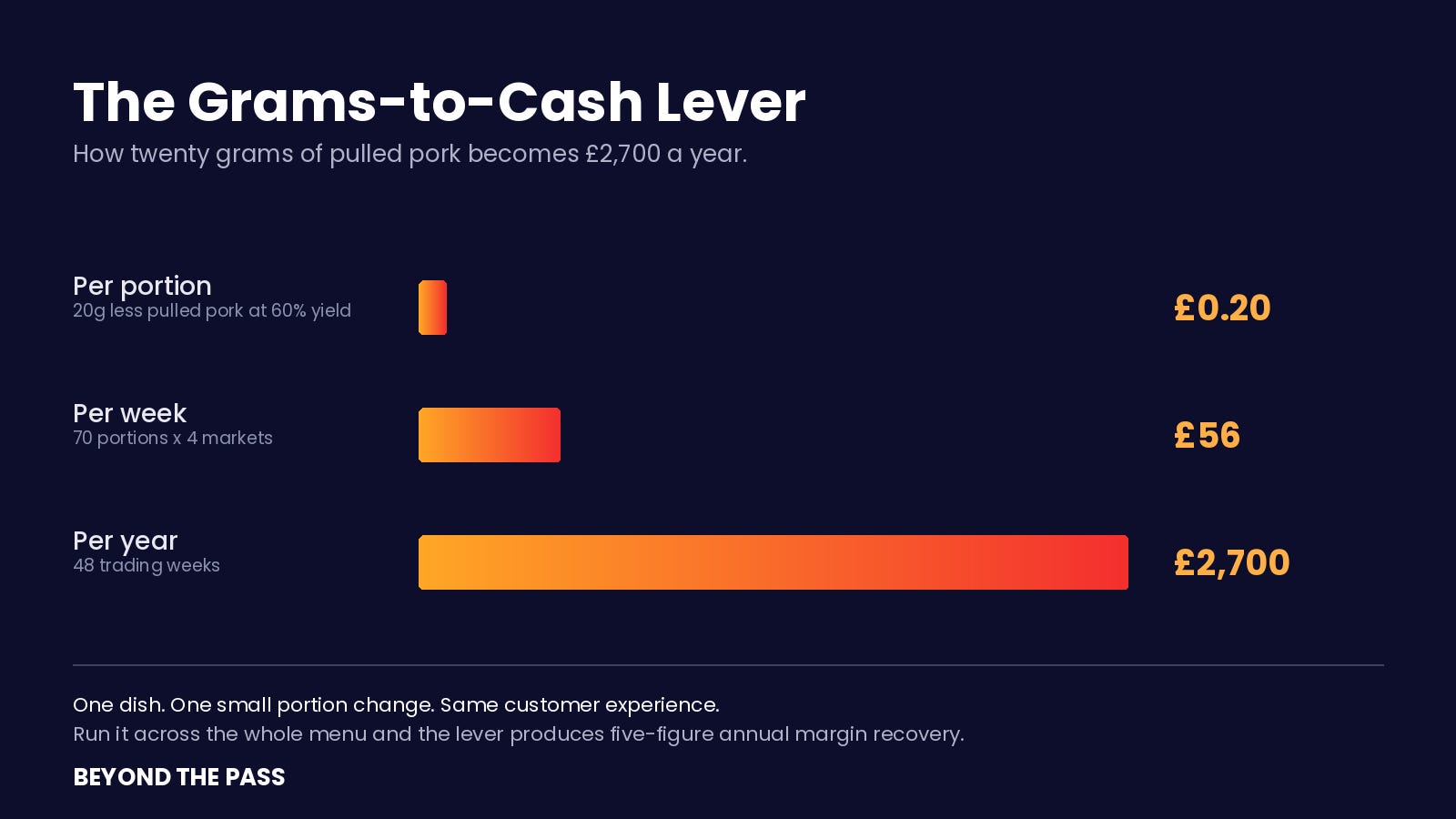
70 portions a Saturday. £14 saved per Saturday. Across four markets a week, £56. Across a 48-week trading year, roughly £2,700 a year in margin from a single 20-gram cut on one dish.
That’s just the headline protein. Run the same maths on every protein on the menu, then on the secondary expensive ingredients (cheese, premium toppings, premium sauces), and the recoverable margin from a single thoughtful portion review compounds into five-figure annual recovery on operations doing modest volume.
The Bristol trader did this across his three core dishes. Pulled pork down 20g. Brisket down 15g (proportional). The premium slaw portion reduced slightly and the bread held the same. Total saving across the menu came to about £1.70 per portion. At his volume, that was the £25,000 a year.
He raised no prices. He added no hours. He just stopped over-portioning by reflex.
Why traders over-portion in the first place
Once you’ve seen the maths, the obvious question is why anyone over-portions to start with. There are three causes and they’re all psychological, not operational.
The first is generosity instinct. Street food traders are often genuinely proud of their food and want customers to feel well-fed. Plating a generous portion feels like good hospitality. It also feels like the right thing to do at a market, where customers are paying premium prices for what they perceive as a treat. The instinct is honourable. It’s also expensive.
The second is competitive paranoia. “The trader next to me does 200 grams, I can’t do 160 or I’ll look stingy.” This is almost always wrong. Customers don’t measure portion sizes against neighbouring stalls. They form an impression based on the plate that arrives. If your plate looks generous and tastes good, they don’t compare gram weights with the unit thirty feet away.
The third is fear of one bad review. A trader who has portioned at 180 grams for two years is genuinely afraid that the first customer to receive 160 grams will notice and write a one-star review. In practice, this almost never happens, because the perception threshold is wider than the change. But the fear is real and it’s what stops most traders from running the test.
The fix for all three is the same: change the portion specification once, hold it for two weeks, and watch the reviews and the repeat customers. The data answers the fear. The Bristol trader watched his reviews for the first month after the change. Nothing moved. No mentions of portion size, no complaints, no drop in five-star ratings. The customers genuinely didn’t notice.
Where the lever stops working
There are situations where portion reduction is the wrong move, and it’s worth being honest about them.
If your portions are already lean, more reduction crosses the visual threshold and starts losing you customers. A trader already at 150 grams of protein for an £11 plate cannot reduce further without consequence. Run the maths on what you currently serve before you reduce. If you’re already at the floor, the lever isn’t available.
If your brand position is explicitly “huge portions, big value,” reducing breaks the promise you’ve made to customers. This applies to a small subset of street food operators who’ve genuinely built their proposition around abundance. For most traders, the brand position is “good food, fair price,” which is portion-neutral.
If the dish format makes the protein highly visible (a steak, a salmon fillet, a whole quail), the threshold is much tighter than 10%. These dishes need a different lever, usually compositional rather than portion-based.
For everything else, which is most pulled and shredded meats, most curries, most rice bowls, most wrap formats, most loaded fries and most assembled dishes, the lever is genuinely there and almost nobody is using it.
Run this on your own street food operation this week
Three steps. About thirty minutes if you have your dish specs and your invoice data to hand.
Step 1. Weigh and document your current portion sizes. Headline protein cooked weight, by dish. Be honest. The portion specification on paper is often different from what actually leaves the unit on a busy Saturday. Weigh ten consecutive portions during service to find the real number.
Step 2. Calculate raw cost per portion. Cooked yield percentage matters. Pork 60%, brisket 55%, chicken thigh 75%, lamb shoulder 58%, beef shin 50%. Convert your cooked portion to raw weight, then to raw cost using your invoice price.
Step 3. Model a 10% reduction. Recalculate raw cost at the new portion. Multiply the per-portion saving by your typical weekly volume on that dish. Then by 48 trading weeks. That’s the annual margin recovery available from that single dish.
Most traders find one or two dishes where the maths produces £3,000 to £6,000 a year of recoverable margin. Across a three-dish menu, total recovery in the £15,000 to £25,000 range is normal, not exceptional.
The customer experience does not change. The reviews do not change. The volume does not change. Only the margin changes.
What the portion lever proves about street food economics
The reason this works, and the reason almost no trader uses it, is that street food culture has built up an emotional relationship with portion size that doesn’t match the customer’s actual perception. Traders measure generosity by the grams on the plate. Customers measure it by the experience they had.
Once you separate those two things, the lever becomes obvious. You can be generous with the customer’s experience (warm welcome, good music at the unit, careful plating, good sauce coverage, attention at the moment of handover) and lean with the cost base, and the customer will walk away happier than they did at 180 grams of pulled pork with a sullen handover.
The fifteen grams aren’t where the customer’s loyalty comes from. They never were.
Next in the street food series: Why £8 feels cheap and £9 kills you. The psychological pricing bands in street food, the gap between perceived value and real margin, and the pricing move that almost always backfires.
Free 15-minute diagnostic that surfaces these numbers for your own operation here.