
Where Contribution Margin Actually Disappears
Small shifts in price, portions, and prep time quietly drain the margin most kitchens think they’re protecting.

🎧 Beyond the Pass — Operator podcast (1:32)
Why a £22 dish that looks like 35% food cost can quietly destroy margin.
Prefer reading? The full breakdown is below.
A dish showing 30–32% food cost usually looks safe.
It sits comfortably within the typical targets most operators watch.
Nothing on the P&L suggests a problem.
But those numbers are often misleading.
Contribution margin rarely disappears in one dramatic mistake.
It leaks through small structural shifts.
The Illusion of “Normal” Food Cost
Consider a typical bistro main.
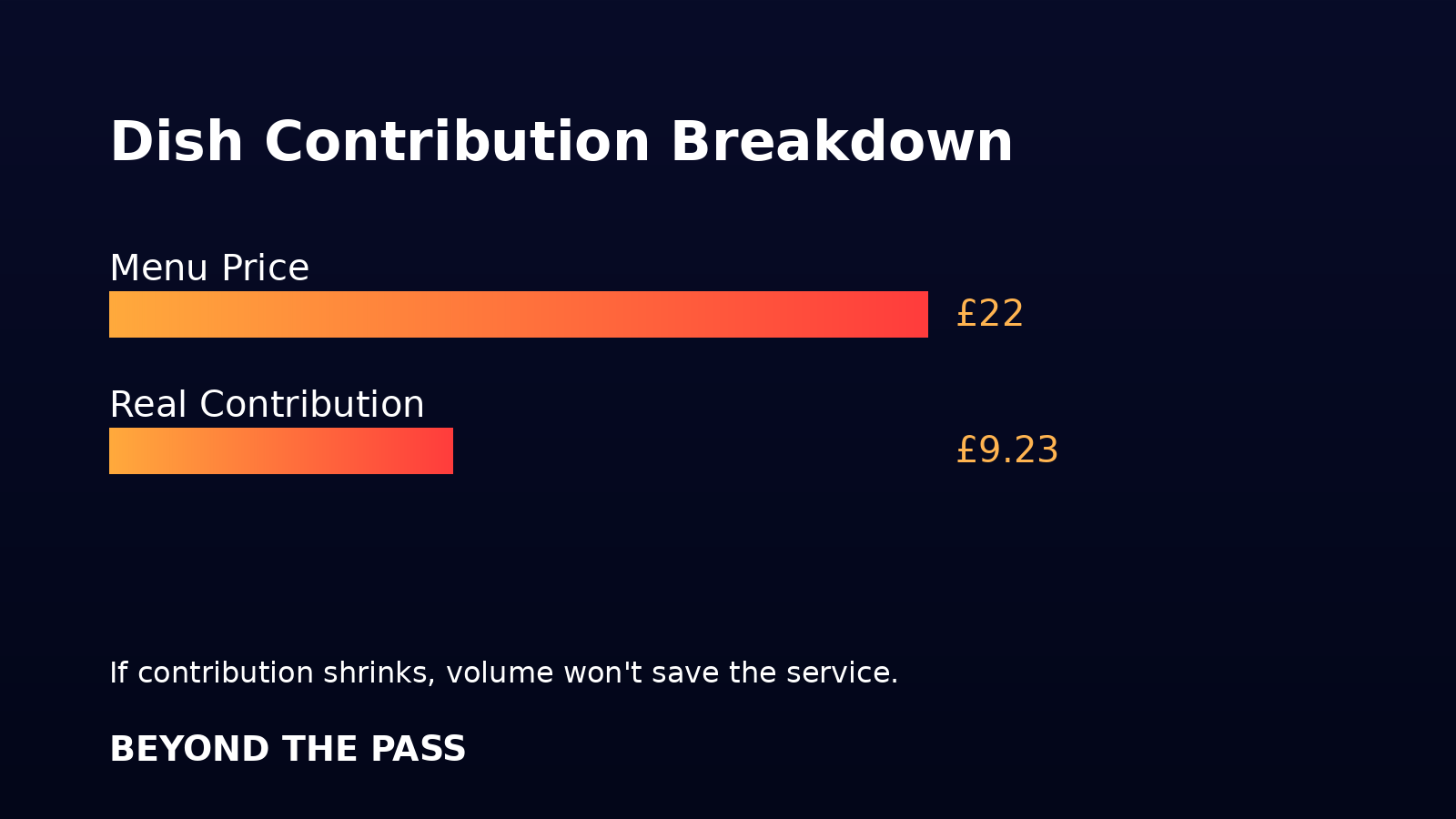
Menu price: £22
Remove VAT:
£18.33 real revenue.
Ingredient cost: £7.80
On paper that is roughly 35% food cost.
Not ideal, but not alarming either.
Most operators would leave it alone.
But that number hides several quiet pressures.
Where the Margin Actually Goes
First comes supplier drift.
A few pence here. A few pence there.
Over months, the ingredient cost quietly moves.
Then comes portion drift.
A slightly heavier scoop. A bit more garnish.
No one intends to change the portion, but it happens.
On this dish the plating had added roughly £1.30 per plate.
Now the real cost sits closer to £9.10.
Food cost suddenly approaches 50% of ex-VAT revenue.
And that still isn’t the full picture.
The Labour Nobody Counts
The dish also required four additional finishing minutes on the pass.
During quiet services, that seems harmless.
During the busiest hour, those minutes matter.
Extra time per plate means:
• tickets stacking
• slower table turns
• fewer covers completed in the peak window
At that point the dish is no longer contributing margin.
It is consuming kitchen capacity.
Why These Problems Stay Hidden
Most restaurants monitor averages.
Weekly food cost.
Weekly labour percentage.
But structural problems rarely show up in averages.
They live inside individual dishes.
A kitchen can run smoothly with one inefficient plate.
Five or six like that begin to shape the entire service.
The Structural Check
When a kitchen feels under pressure, operators often jump to the same conclusion.
Hire another chef.
Raise prices.
Cut labour.
But those decisions should come after one question is answered:
What does each dish actually contribute?
Until that is clear, every operational change is guesswork.
The Next Step
Before changing staffing or pricing, check where your margin actually comes from.
I built a simple diagnostic to surface these structural leaks quickly.
Run the free kitchen diagnostic:
beyondthepass.org